---
title: AI coaching skills for Bloom Growth coaches
description: A five-module program teaching Bloom Growth coaches to run AI-augmented practices — including weekly meeting audits no other BGOS coach offers.
---
[bloomwith*rich*](https://www.bloomwithrich.com/?hsLang=en)
[About](https://www.bloomwithrich.com/about?hsLang=en)
[Approach](https://www.bloomwithrich.com/approach?hsLang=en)
[Work With Me](https://www.bloomwithrich.com/work-with-me?hsLang=en)
[For Founders & Leadership Teams Install BGOS. Free the founder. Lead with cadence.](https://www.bloomwithrich.com/work-with-me/founders?hsLang=en) [For Bloom Coaches AI in your coaching practice. Claude, Cowork, Code, skills.](https://www.bloomwithrich.com/work-with-me/coaches?hsLang=en) [The Transferable Value Index How much runs without you? Twelve questions, four minutes.](https://www.bloomwithrich.com/value-index?hsLang=en)
[Speaking](https://www.bloomwithrich.com/speaking?hsLang=en)
[Contact](https://www.bloomwithrich.com/contact?hsLang=en)
[Get Flourish — free](https://www.bloomwithrich.com/en-us/claim-your-free-copy-of-flourish-rich-palarea?hsLang=en)
[bloomwith*rich*](https://www.bloomwithrich.com/?hsLang=en)
[About](https://www.bloomwithrich.com/about?hsLang=en) [Approach](https://www.bloomwithrich.com/approach?hsLang=en) [Work With Me](https://www.bloomwithrich.com/work-with-me?hsLang=en) [For Founders & Leadership Teams](https://www.bloomwithrich.com/work-with-me/founders?hsLang=en) [For Bloom Coaches](https://www.bloomwithrich.com/work-with-me/coaches?hsLang=en) [The Transferable Value Index](https://www.bloomwithrich.com/value-index?hsLang=en) [Speaking](https://www.bloomwithrich.com/speaking?hsLang=en) [Contact](https://www.bloomwithrich.com/contact?hsLang=en) [Get Flourish — free](https://www.bloomwithrich.com/en-us/claim-your-free-copy-of-flourish-rich-palarea?hsLang=en)
---
For Bloom coaches
# AI for the coach who's already *in the seat*.
How to use Claude — chat, Cowork, Code, Design, and skills — to sharpen your practice, scale what you do best, and reclaim hours from the work that doesn't need you. *Go do the work that only humans do. Leverage AI for the rest.*
---
Why this matters
## The coach's edge is pattern-recognition under pressure. AI *amplifies* it.
Coaching has always been about seeing the pattern under the pressure — the move the team can't see because they're inside it. That's not something AI replaces. It's something AI makes louder. Faster prep, sharper critique, frameworks that compound across clients, content that goes out without eating your week. The gain is real, and it's already showing up in the practices of the coaches who started early.
Most coaches are still on the sideline — watching, waiting for the noise to die down before they try anything. The risk in that posture isn't that AI replaces coaches. It's that the coaches who've integrated it are running with a multiplier on the same number of hours, and the gap widens quarter over quarter. **This page is for the coach who'd rather close that gap than watch it open.**
What you'll learn
## Five surfaces of Claude. Five different shapes of practice gain.
01
### Claude (chat).
The conversational interface most coaches already know about. What changes when you stop using it as a search box and start using it as a thinking partner — prep for a session, debrief after a hard one, pattern-spot across notes from twelve clients, and the real unlock: *do the hard work of self-awareness so you can show up the way you need to*. The leverage isn't in the answers; it's in the questions you stop having to formulate alone.
02
### Cowork.
Claude on your computer, in your files. Reads the documents you already have, writes new ones beside them, runs your weekly meeting audits without leaving your folder structure. The mode that stitches AI into your daily ops — not a separate window you have to remember to open.
03
### Claude Code.
The coding agent. For coaches who want to build tools — not as side projects, but as compounding leverage. The Bloom Growth Engine (below) is what gets built when a coach with no engineering background pairs with Claude Code for a launch in a week and ongoing refinement as you use it.
04
### Design.
Visual work alongside Claude. Slide decks that match your brand without a designer in the loop. One-pagers, frameworks, client handouts — generated, refined, and ready in the time a single coffee takes. Claude is rapidly becoming a capable visual collaborator, and the coaches who use it that way move at a different speed.
05
### Skills.
Packaging your own expertise so Claude can apply it on demand. Your frameworks, your scripts, your standard operating procedure for a 1:1 — wrapped up so Claude executes them the way you would. *Skills are how a coaching practice's IP stops living only in one head.*
Working proof
## Not a demo. The thing *powering your read of his posts* this week.
Time reclaimed
Was
~3 hrs
per week · manual
→
Is
~10 min
per week · Engine
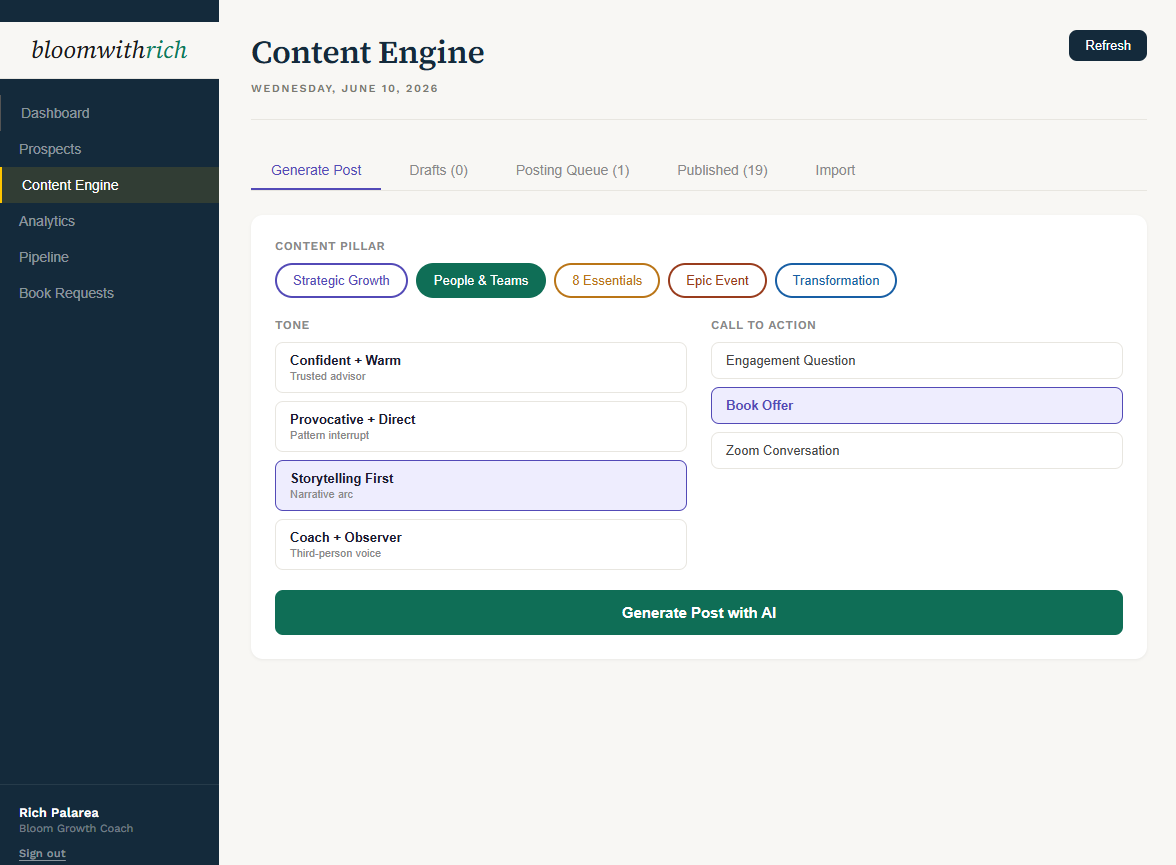
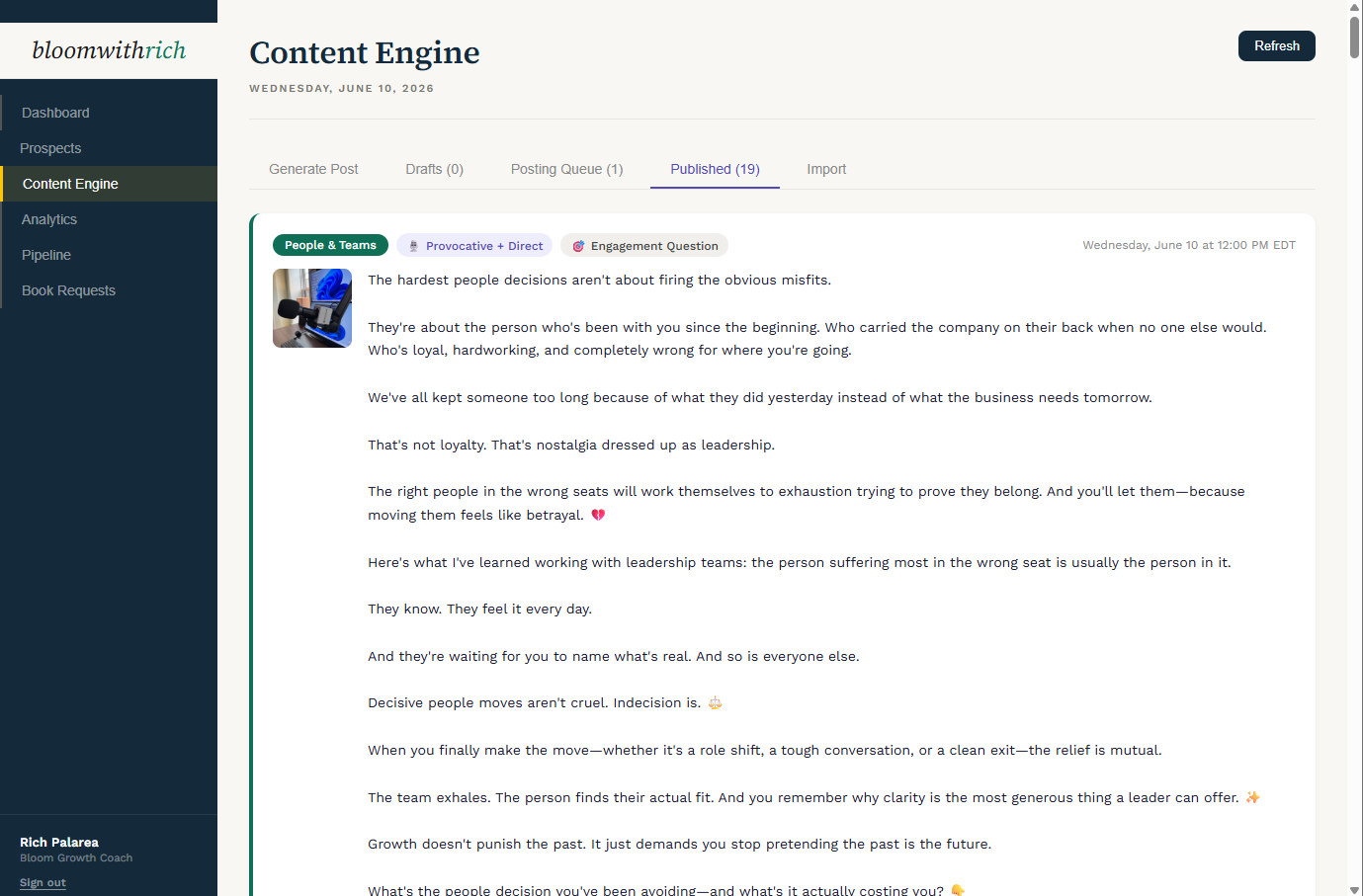
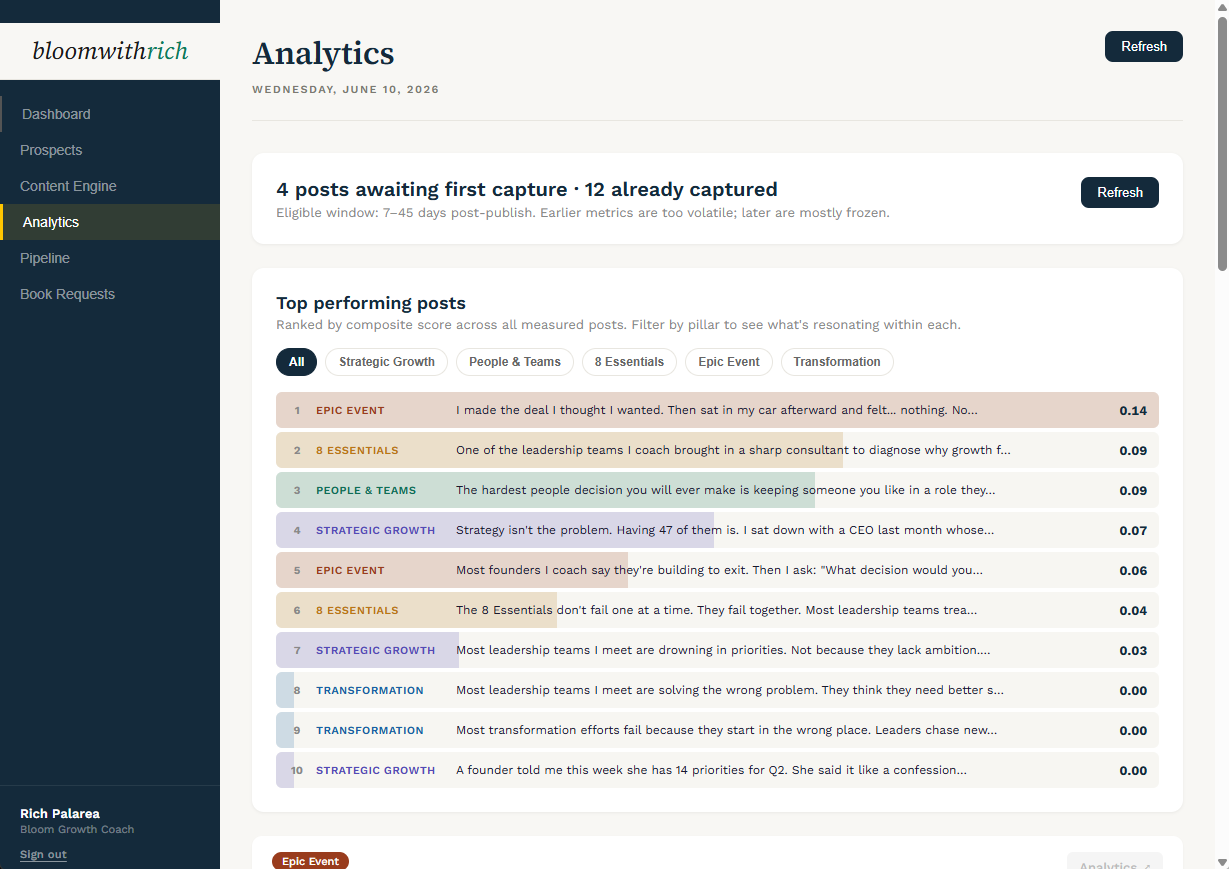
Five minutes generating a week of posts — matched with photos, formatted for LinkedIn, informed by prior analytics. *No guessing what's worth posting.* Five minutes drag-and-drop ingesting fresh performance data. The rest of your week back.
The Bloom Growth Engine is an AI-powered top-of-funnel CRM that Rich built with Claude over the past several months. It drafts LinkedIn posts in his voice, schedules them, captures engagement signal from LinkedIn's per-post analytics, and scores every post on a three-axis model — CTA-fit × CTA-altitude × ICP-fit — to surface what's actually working. The top-performing posts get fed back as few-shot exemplars, so the AI gets better at his voice over time.
It also handles his book-request funnel end to end. When someone claims a free copy of *Flourish*, the request lands in HubSpot, flows through Make.com into the Engine's database, gets enriched with engagement context, and surfaces in a pipeline view Rich works from each week. The Bloom Weekly Meeting audits described on the Founders page run through this same system.
If you've been reading [Rich's posts](https://www.linkedin.com/in/rpalarea/recent-activity/all/) this week, the Engine is what put them in your feed. It's not a screenshot collection. *It's a live, working system that one coach built with Claude* — and the architecture of it is exactly the kind of compounding tool other coaches could be building too.
 ⤢ Click to enlarge
 ⤢ Click to enlarge
 ⤢ Click to enlarge
Built on React, Supabase, the Anthropic API, HubSpot, Make.com, and Vercel — by a coach, not a developer. The stack is conventional; the gain is in the architecture and the iteration loop.
×
How Rich teaches it
## Three ways in.
### [01 1:1 coach mentorship. Recurring one-on-one work on your own AI practice. We meet on a regular cadence, dig into what you're building, where you're stuck, what's compounding and what's not. Paid retainer. Right for coaches who already have an AI practice in motion and want a thinking partner who's two or three steps ahead on the same path. Book a 20-minute call](https://www.bloomwithrich.com/book?hsLang=en)
### [02 Case-study workshops. Periodic group sessions for coaches who want to learn from real builds. We walk through actual Engine architecture, recent Anthropic use cases, and the decisions behind them — what worked, what didn't, what we'd do differently. Q&A is the point; the lecture is the warm-up. Right for coaches earlier in the journey who want exposure before committing to a build. Book a 20-minute call](https://www.bloomwithrich.com/book?hsLang=en)
### [03 Build-alongside-me pairing. Paid intensive sessions. You bring a real problem from your practice; we build the solution together, live, using Cowork and Claude Code. By the end of the session, you have a working tool — and the muscle to extend it on your own. Right for coaches who learn by doing and want a compressed leap rather than a slow accumulation. Book a 20-minute call](https://www.bloomwithrich.com/book?hsLang=en)
Next step
## Twenty minutes. Coach to coach. *No pitch.*
If anything on this page sounds like the next step for your practice, the right move is a short conversation. Twenty minutes, peer to peer. We talk about where your practice is, what AI surfaces you've touched or avoided, and which of the three modes above fits where you are. If it's not the right time, we'll say so — and you'll leave with a couple of specific things to try on your own anyway.
[Book a 20-minute call](https://www.bloomwithrich.com/book?hsLang=en) [Get Flourish](https://www.bloomwithrich.com/en-us/claim-your-free-copy-of-flourish-rich-palarea?utm_source=homepage&utm_medium=closing&utm_campaign=flourish&hsLang=en)
Same operator-to-coach arc, different application. Still worth reading if you haven't.
[bloomwith*rich*](https://www.bloomwithrich.com/?hsLang=en)
Growth coaching for founders and leadership teams. Built on the Bloom Growth Operating System.
 Signed by
Resources
- [Flourish — free book](https://www.bloomwithrich.com/en-us/claim-your-free-copy-of-flourish-rich-palarea?hsLang=en)
- [The Bloom Growth OS](https://bloomgrowth.com)
- [Book a 20-min call](https://www.bloomwithrich.com/book?hsLang=en)
Connect
© 2026 Richard D. Palarea. All rights reserved.
[Privacy](https://www.bloomwithrich.com/privacy?hsLang=en) [Legal](https://www.bloomwithrich.com/legal?hsLang=en)